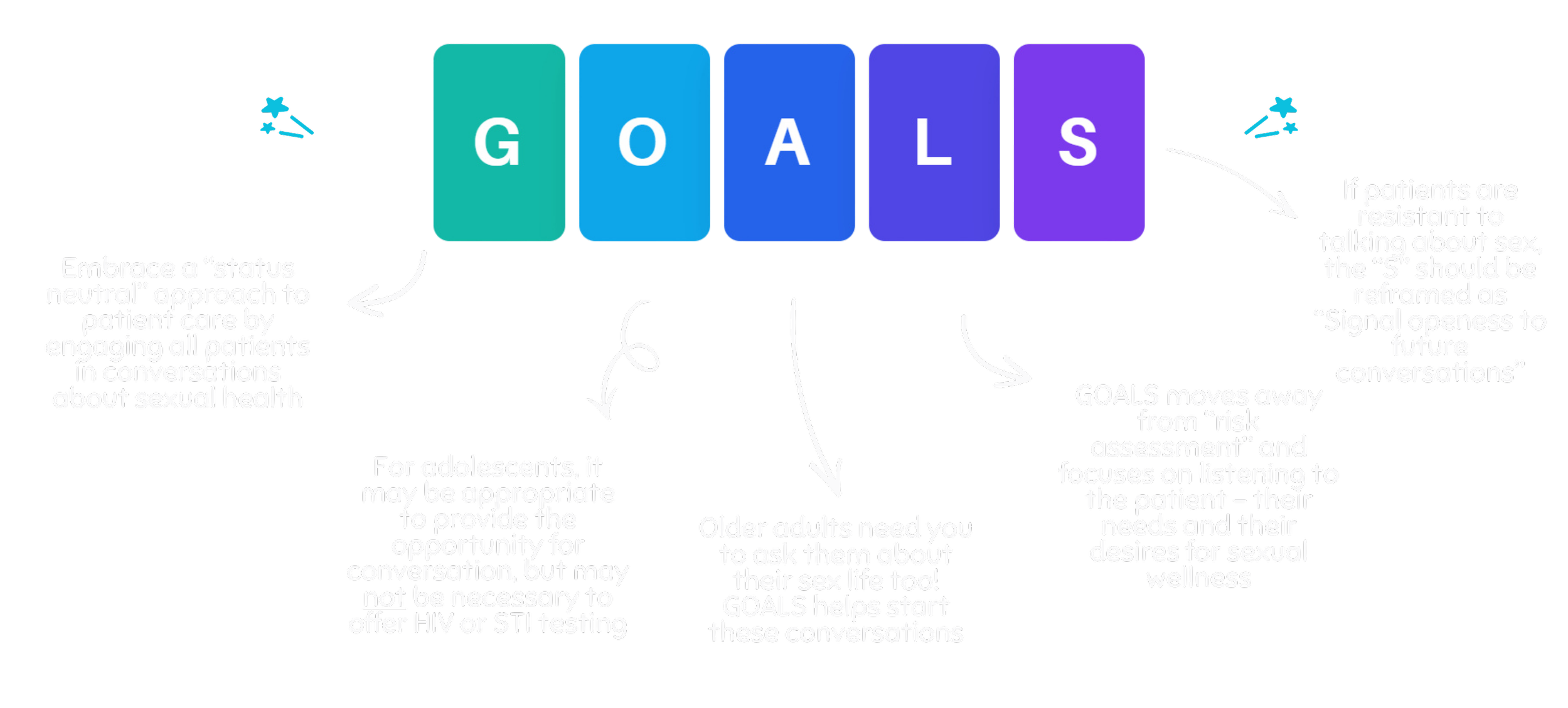
Learn about each step in the
GOALS
Approach
See sample patient-provider dialogue and explore the evidence-based rationale
G
Give a preamble that emphasizes sexual health
The healthcare provider briefly introduces the sexual history in a way that de-emphasizes risk, normalizes sexuality as part of routine healthcare, and opens the door for the patient's questions.
"I'd like to talk with you for a couple of minutes about your sexuality and sexual health. I talk to all of my patients about sexual health, because it's such an important part of overall health. Some of my patients have questions or concerns about their sexual health, so I want to make sure I understand what your questions or concerns might be and provide whatever information or other help you might need."
- Focuses on sexual health, not risk
- Normalizes sexuality as part of health and healthcare
- Opens the door for the patient's questions
- Clearly states a desire to understand and help
O
Offer opt-out HIV/STI testing and information
The healthcare provider tells the patient that they test everyone for HIV and STIs, normalizing both testing and HIV and STI concerns.
"First, I like to test all my patients for HIV and other sexually transmitted infections. Do you have any concerns about that?"
- Doesn't commit to specific tests, but does normalize testing
- Sets up the idea that you will recommend some testing regardless of what the patient tells you
- Opens the door for the patient to talk about HIV or STIs as a concern
A
Ask an open-ended question
The healthcare provider starts the sexual history with an open-ended question that helps them identify the aspects of sexual health that are most important to the patient, while allowing them to hear (and then mirror) the language that the patient uses to describe their own body, partner(s), and sexual behaviors.
"Tell me about your sex life? What would you say are your biggest sexual health questions or concerns? How is your current sex life similar or different from what you think of as your ideal sex life?"
- Puts the focus on the patient
- Lets you hear what the patient thinks is most important first
- Lets you hear the language the patient uses to talk about their body, partners, and sex
L
Listen for relevant information and probe to fill in the blanks
The healthcare provider asks more pointed questions to elicit information needed for clinical decision-making (e.g., 3-site versus genital-only testing), while limiting questions to information that is clinically necessary. For example, if a patient has already disclosed that he is a gay man with more than one partner, there is no need to ask about the total number of partners or their HIV status to recommend STI/HIV testing and pre-exposure prophylaxis (PrEP) education.
"Besides [partner(s) already disclosed], tell me about any other sexual partners? How do you prevent pregnancy (unless you are trying to have a child)? How do you protect yourself against HIV and STIs? What would help you take (even) better care of your sexual health?"
- Makes no assumption about monogamy or the gender of partners
- Avoids setting up a script for over-reporting condom use
- Can be asked of patients regardless of gender
- Increases motivation by asking the patient to identify prevention strategies
S
Suggest a course of action
Consistent with opt-out testing, the healthcare provider offers all patients HIV testing, 3-site STI testing, PrEP education, and contraceptive counseling unless any of these services are specifically contraindicated by the sexual history. Rather than focusing on risk behaviors, this step emphasizes the benefits of prevention, including greater control over sexual health and reduced anxiety about possible transmission.
"So, as I said before, I'd like to test you for [describe tests indicated by the sexual history conversation]. I’d also like to give you information about PrEP/contraception/other referrals. I think it might be able to help you [focus on benefit]."
- Allows you to tailor STI testing so the patient doesn't feel targeted
- Shows that you keep your word
- Allows you to frame education or referrals in terms of benefits that are relevant to the individual patient
GOALS was developed for primary care and has been adapted for other settings