

Implementation Research
on GOALS
in Practice
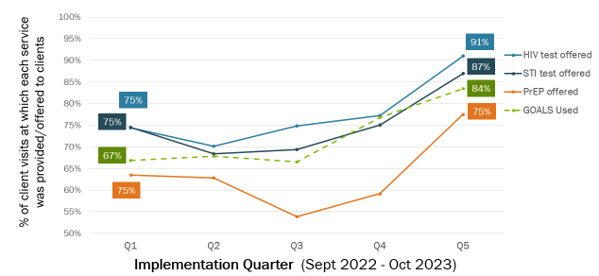
GOALS utilization was associated with significant increases in intervention uptake
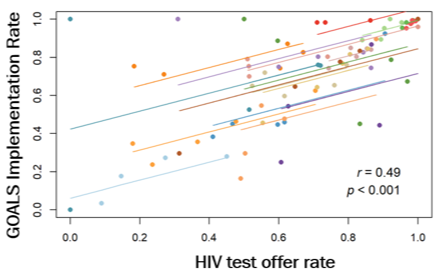
In a CDC-funded implementation study conducted with 18 agencies, GOALS utilization was associated with significant increases in the number of visits in which providers offered HIV testing, STI testing, and PrEP to their patients.
Citation: Golub, S.A., Hubbard S, de Roche AM, Barton SC, Merges A, Klein A. Community–academic implementation science partnership to examine adoption and impact of a patient-centered approach to sexual history. Psychological Services. 2025; 22(4):699-709.

Agency Staff Assessment of Relative Advantage of GOALS Compared to Traditional Risk Assessment
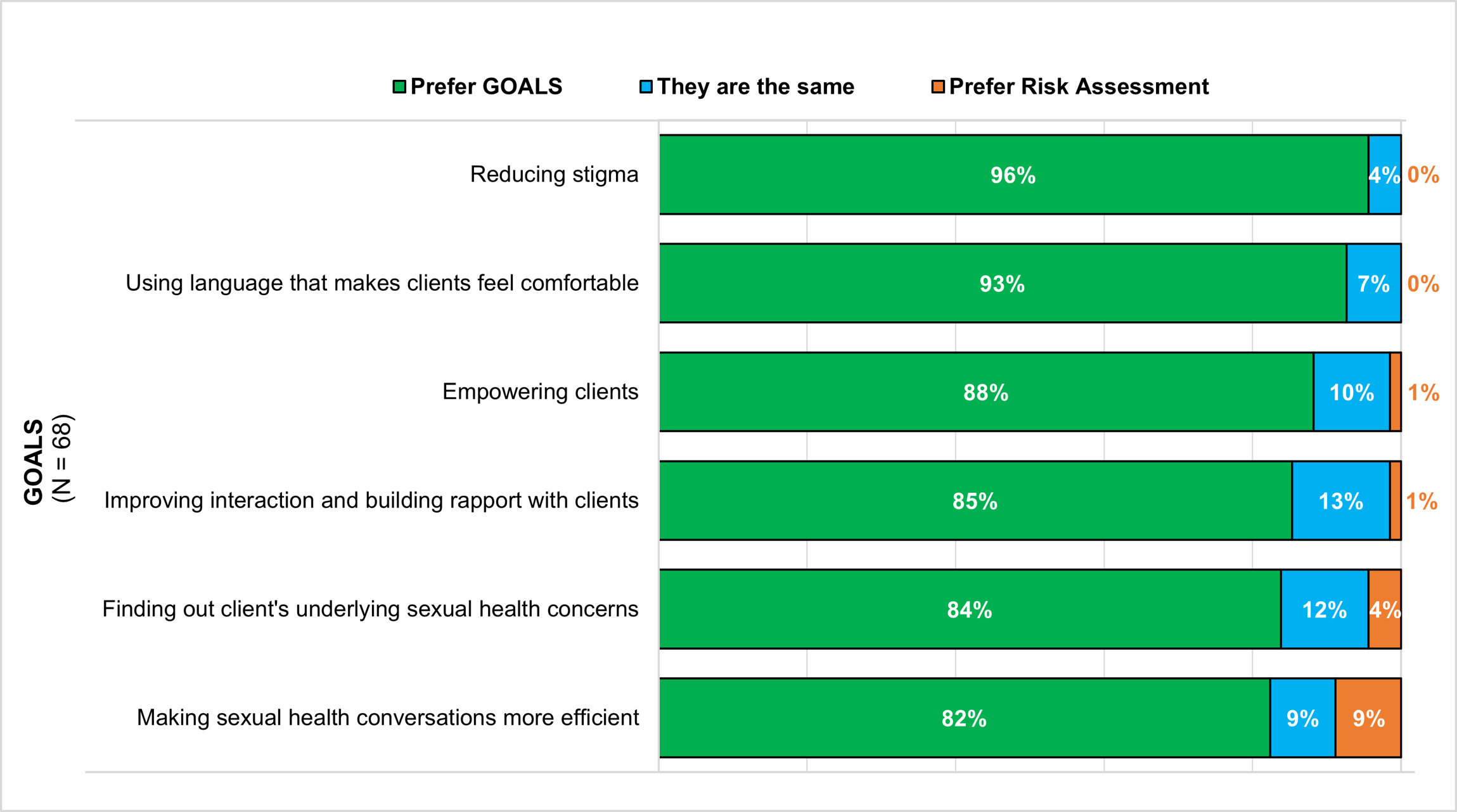
GOALS relative advantage versus traditional risk assessment
In the same CDC-funded study, providers who used GOALS (n = 68) overwhelmingly endorsed the framework’s “relative advantage” compared to traditional risk assessment, reporting that it was better at reducing stigma, empowering clients, improving interaction and building rapport, finding out clients’ underlying health concerns, and making sexual health conversations more efficient .
Citation: Golub, SA, de Roche AM, Starbuck, L, Hall, I, & Wilbourn, B. Implementation outcomes and lessons from a Health-Department-driven quality-based financing approach to HIV prevention programs in New York City: A mixed methods analysis. JAIS, accepted July 24, 2026.

In qualitative interviews, providers who have used GOALS (n = 31) reported that it increases client engagement and service access, normalizes sexual healthcare, destigmatizes sexual health conversations, and supports providers in addressing patients’ needs.
“I think what I like about it most is we can hear about how a patient wants to talk about their own sex life or their own body first. And then, I can mimic that language instead of using something that might feel judgmental or just uncomfortable, overly scientific, whatever it might be.”
“[GOALS] gets you to where you need to be faster in the end…actually, we end up saving a ton of time because you’re not trying to dig at what you’re getting to.”
“The conversations just feel more personal using the GOALS approach instead of going down a checklist of questions to ask.”
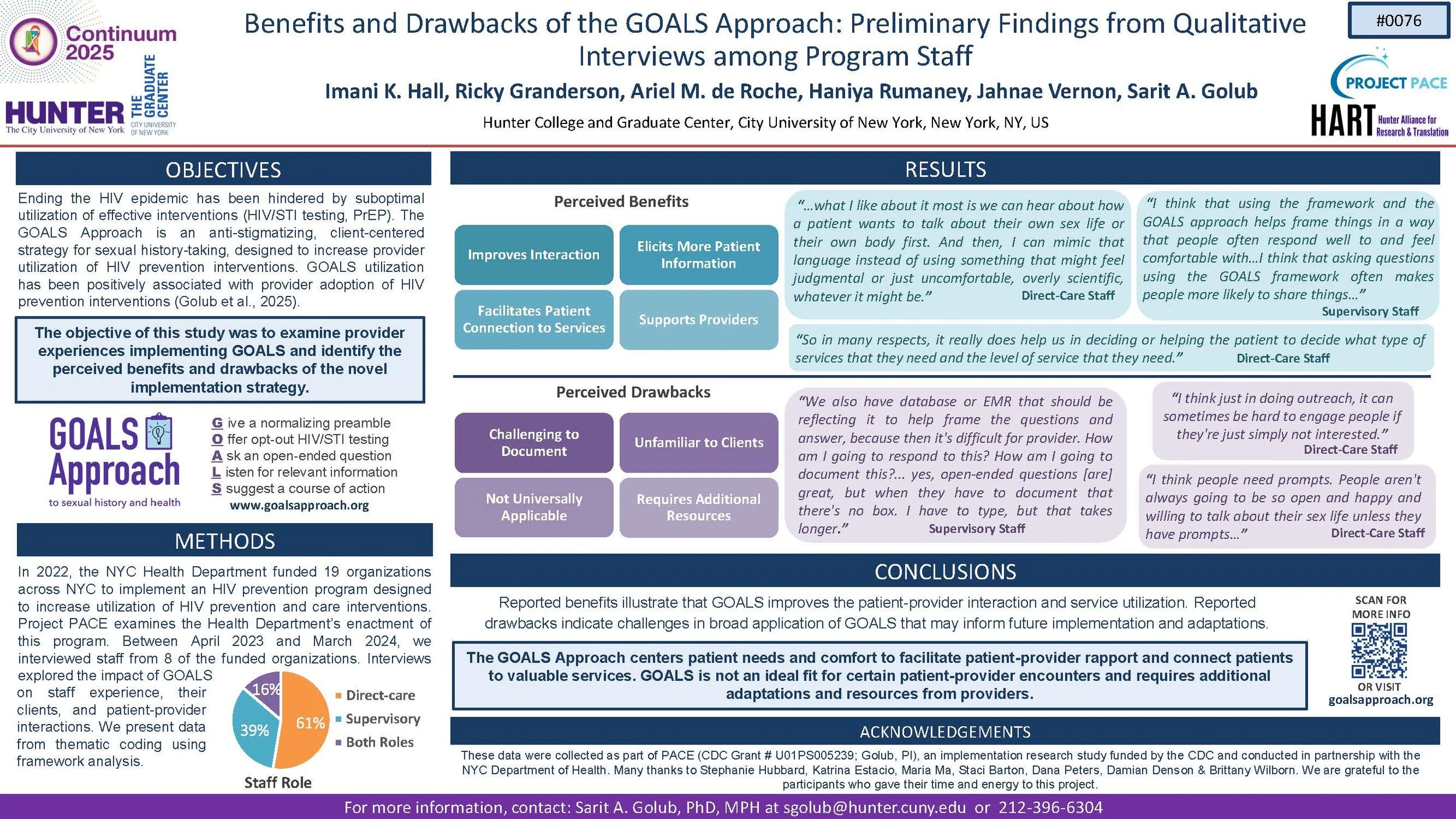
Citation: Hall, I.K, Granderson, R., de Roche, A., Rumaney, H., Vernon, J., & Golub, S.A. (2025, June 10-12). Benefits and Drawbacks of the GOALS Approach: Preliminary Findings from Qualitative Interviews among Program Staff [Poster presentation]. Continuum 2025, the 20th International Conference on HIV Treatment and Prevention Adherence, San Juan, Puerto Rico.
See how other clinics and programs have incorporated the GOALS approach
-
NYC 2020 Ending the Epidemic Plan
Use of the GOALS Approach is recommended to implement the New York City Ending the Epidemic Plan and New York City 2020: Ending the HIV Epidemic: A Plan for America Plan
-
New York State Department of Health AIDS Institute
The New York State Department of Health AIDS Institute recommends the GOALS Approach as part of their Clinical Guidelines Program.
-
University of Cincinnati College of Nursing
In this webinar from the University of Cincinnati College of Nursing, Jan Stockton, MSN, RN, AACRN, ACNS, discusses the GOALS Approach.
-
PlaySure Network 2.0
PlaySure Network 2.0 for HIV Prevention encourages providers to use the GOALS Approach when taking a sexual history.